
Ovulation is the central physiological event of every menstrual cycle. Whether you are actively planning a pregnancy or seeking a deeper understanding of your hormonal rhythms, identifying your fertile window provides essential insight into your reproductive health.
At Rose Maternity and Children Hospital in Bharuch, our obstetrics and women’s health team—led by Dr. Vidya Lakshmi Kachhela—emphasizes patient education, cycle awareness, and evidence-based clinical monitoring.
📅 Interactive Ovulation & Fertile Window Calculator
The calculator below estimates your fertile window and next expected ovulation day using menstrual cycle chronobiology.
🌸 Ovulation & Fertile Window Calculator
🔬 The Physiology of Ovulation: Hormonal Orchestration
Ovulation is the biological process wherein a mature ovarian follicle ruptures and releases an oocyte (egg) into the fallopian tube, primed for potential fertilization. This process is governed by the Hypothalamic-Pituitary-Ovarian (HPO) axis, requiring synchronized signaling between brain structures and ovarian tissue.
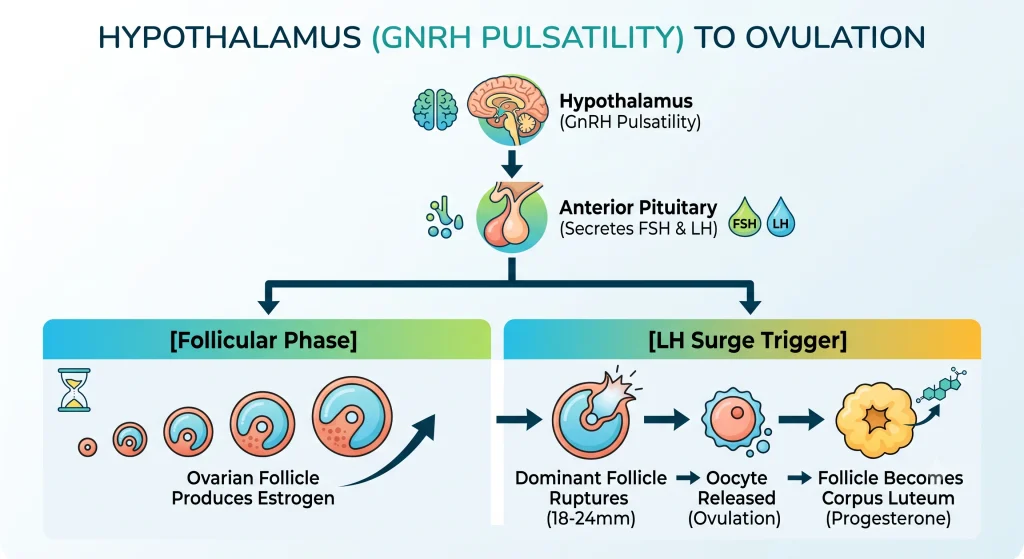
The Three Functional Phases of the Ovarian Cycle
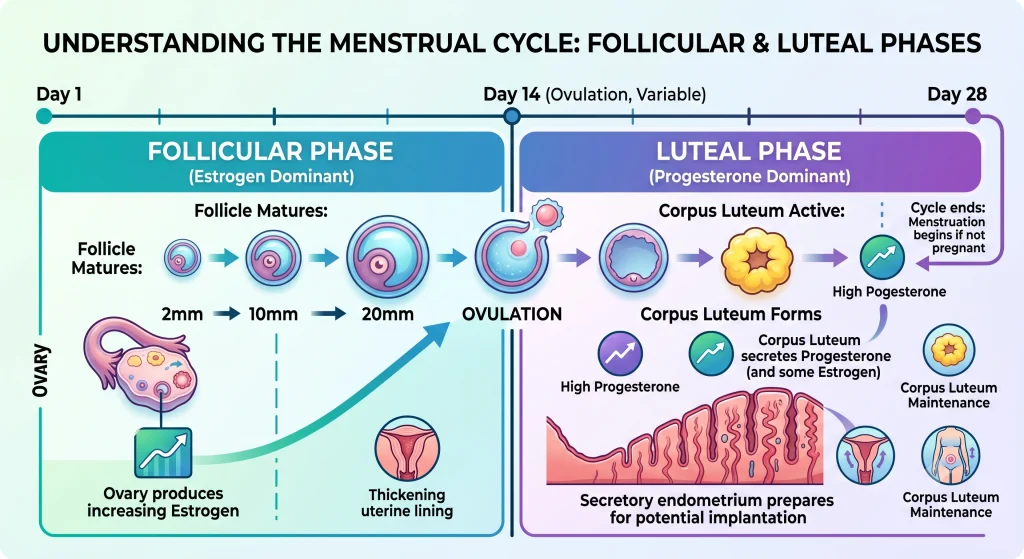
1. The Follicular Phase (Days 1 to ~13)
- The hypothalamus secretes pulses of Gonadotropin-Releasing Hormone (GnRH), prompting the anterior pituitary gland to produce Follicle-Stimulating Hormone (FSH) and Luteinizing Hormone (LH).
- FSH recruits a cohort of primordial ovarian follicles. Over several days, one follicle emerges as dominant due to its higher density of FSH receptors.
- This dominant follicle (Graafian follicle) secretes increasing amounts of $17\beta\text{-estradiol}$ (estrogen). Rising estrogen promotes proliferation of the uterine endometrium, preparing a receptive lining.
2. The Ovulatory Surge (Days 13 to 15)
- When circulating estradiol reaches a sustained high threshold (typically $>200\text{ pg/mL}$ for 48 hours), it exerts positive feedback on the pituitary gland.
- This triggers the Luteinizing Hormone (LH) surge, causing circulating LH levels to rise dramatically.
- The LH surge activates proteolytic enzymes (collagenases and plasminogen activators) within the follicular wall, leading to thinning of the ovarian capsule and extrusion of the mature secondary oocyte approximately 24 to 36 hours after the onset of the surge (and 10 to 12 hours after its peak).
3. The Luteal Phase (Days 15 to 28)
- Following release of the oocyte, the collapsed follicular shell reorganizes into a transient endocrine structure: the corpus luteum.
- Driven by low-level LH signaling, the corpus luteum secretes substantial quantities of progesterone alongside secondary estrogen.
- Progesterone halts endometrial proliferation, converting the lining into a vascular, secretory state. If fertilization does not occur within 12–24 hours, the corpus luteum undergoes luteolysis (regression), progesterone drops, and the functional endometrial layer sheds as menstrual flow.
🎯 The Fertile Window: Cellular Lifespans Explained
The biological fertile window encompasses the specific time frame within a menstrual cycle during which intercourse can lead to conception.
Contrary to the belief that conception can occur at any point in the cycle, pregnancy is biologically constrained by the differing lifespans of human gametes:
| Gamete | Biological Lifespan | Optimal Functional Window | Transport Timeline |
| Spermatozoa (Sperm) | 72 to 120 hours (3 to 5 days) | 24 to 48 hours within fertile mucus | Reaches ampulla of fallopian tube within minutes to hours |
| Oocyte (Egg) | 12 to 24 hours | 6 to 12 hours post-rupture | Viability diminishes rapidly past 12 hours post-ovulation |
Because sperm can survive within estrogen-primed, alkaline cervical mucus for several days, the fertile window spans 6 consecutive days: the 5 days preceding ovulation plus the day of ovulation itself. Clinical pregnancy rates are highest when intercourse takes place within the 48-hour window prior to ovulation, ensuring viable sperm are already present in the fallopian tube when the oocyte emerges.
🌡️ Physical Signs and Biomarkers of Ovulation
Learning to interpret your body’s physical signs helps correlate mathematical predictions with real-time biological changes.
1. Cervical Mucus Dynamics (The Billings Method)
Under the influence of rising follicular estrogen, the cervical crypts alter fluid secretions:
- Early Cycle (Dry/Infertile): Low volume, thick, sticky, acidic; acts as a barrier to sperm.
- Approaching Ovulation (Transitional): Damp, cloudy, creamy consistency.
- Peak Fertile Phase (Spinnbarkeit): Transparent, watery, slippery, and stretchy—similar to raw egg white. This estrogen-rich mucus exhibits a higher pH that preserves sperm vitality, nourishes spermatozoa, and forms parallel micro-channels guiding them into the uterine cavity.
2. Basal Body Temperature (BBT) Shifts
- Pre-Ovulatory Phase: Estrogen maintains a lower baseline temperature, typically ranging from 36.1°C to 36.4°C (97.0°F to 97.6°F).
- Post-Ovulatory Thermal Shift: Following follicle rupture, progesterone produced by the corpus luteum acts directly on the hypothalamic thermoregulatory center. This causes a sustained upward shift of 0.3°C to 0.5°C (0.5°F to 1.0°F).
- Clinical Application: Because the thermal shift occurs after ovulation has already taken place, BBT charting is retrospective. It confirms whether a cycle was ovulatory rather than forecasting the fertile window in advance.
3. Mittelschmerz (Mid-Cycle Discomfort)
Roughly 20–30% of women experience lower pelvic discomfort near ovulation, termed Mittelschmerz (German for “middle pain”):
- Mechanism: Mild peritoneal irritation caused by localized expansion of the follicular capsule prior to rupture, or small amounts of follicular fluid/blood contacting the pelvic peritoneum upon release.
- Characteristics: Unilateral (one-sided), dull or sharp ache lasting anywhere from several minutes to a few hours.
4. Secondary Estrogenic & Luteal Symptoms
- Light mid-cycle spotting (caused by a transient dip in estrogen immediately preceding the progesterone rise).
- Increased breast firmness or sensitivity.
- Increased cervical openness, softness, and elevated position (detectable upon self-examination).
- Heightened libido coinciding with peak LH levels.
📊 Methods for Tracking Ovulation: A Comparative Overview
| Method | How It Works | Clinical Accuracy | Practical Advantages | Limitations |
| Calendar Calculators | Subtracts standard luteal length from historical cycle averages | Moderate for strictly regular cycles; low for irregular cycles | Free, zero-equipment, useful for baseline tracking | Assumes static luteal duration; cannot anticipate unexpected cycle delays |
| Cervical Mucus Charting | Daily tracking of vulvar sensation and mucus elasticity | Moderate to High (when consistently monitored) | Natural, zero cost, provides early warning of approaching ovulation | Affected by vaginal infections, lubricants, antihistamines, or arousal fluid |
| Basal Body Temperature | Daily waking temperature recording with a 2-decimal thermometer | High for retrospective confirmation | Inexpensive, clearly identifies biphasic ovulatory cycles | Retrospective only; disturbed by poor sleep, shift work, alcohol, or fever |
| Urine LH Strips (OPKs) | Immunoassays detecting the urinary LH surge threshold (usually $\ge 25\text{ mIU/mL}$) | High (anticipates ovulation 24–36 hours prior) | Easy home testing, objective color or digital line readout | Can display false positives in women with elevated baseline LH (e.g., PCOS) |
| Follicular Sonography (TVS) | Serial transvaginal ultrasound measuring antral follicle growth and endometrial thickness | Gold Standard (Near 100% Diagnostic Accuracy) | Direct visualization of follicle diameter, endometrium trilaminar pattern, and rupture verification | Requires in-clinic visits with an experienced gynecologist |
🏥 Clinical Gold Standard: Follicular Ultrasound Monitoring
While home tracking tools provide valuable estimates, Follicular Ultrasound Monitoring (TVS) remains the definitive medical modality for tracking ovulation. Performed directly in our outpatient gynecology department at Rose Hospital in Bharuch, serial follicular scans observe the growth and release of the egg in real time.
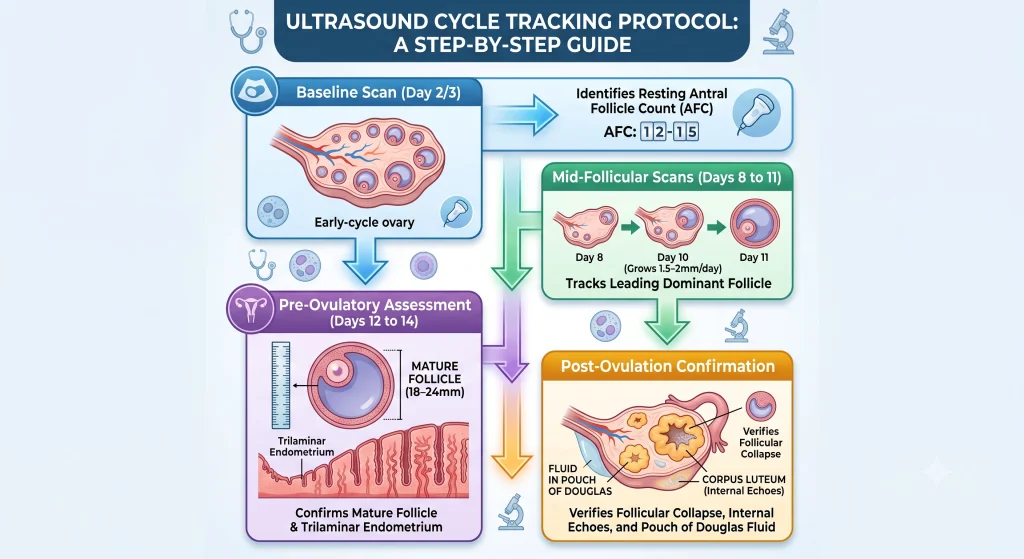
Key Ultrasound Biomarkers Evaluated by Dr. Vidya Lakshmi Kachhela
- Follicular Growth Kinetics: Antral follicles typically expand at a steady rate of 1.5 to 2 mm per day under FSH stimulation. Follicular maturation is achieved when the mean diameter reaches 18 to 24 mm.
- Endometrial Architecture: In addition to follicle size, reproductive success depends on endometrial development. We measure both:
- Thickness: A pre-ovulatory stripe thickness of 8 to 12 mm.
- Morphology: A distinct “triple-line” or trilaminar pattern, indicating healthy estrogenic proliferation of the functional mucosal layer.
- Definitive Rupture Confirmation: A follow-up scan documents the physical collapse of the dominant follicle, conversion into a thick-walled corpus luteum, and the presence of clear fluid in the rectouterine pouch (Pouch of Douglas). This confirms that the egg was successfully released rather than trapped inside an unruptured structure (such as in Luteinized Unruptured Follicle syndrome).
⚠️ Recognizing Anovulation & Cycle Irregularities
Anovulation occurs when an ovary fails to release an oocyte during a menstrual cycle. While a woman experiencing anovulation may still experience periodic uterine bleeding (due to estrogen breakthrough bleeding), these cycles lack true luteal support and regular fertile windows.
Common Clinical Indicators of Anovulatory Patterns
- Oligomenorrhea or Amenorrhea: Menstrual cycles lasting longer than 35 days, or the complete absence of periods for more than 90 days.
- Polymenorrhea: Cycles recurring in fewer than 21 days, often indicating insufficient follicular development or a shortened luteal phase.
- Unpredictable Bleeding: Menses that fluctuate between very light spotting and unusually heavy, protracted flow.
- Monophasic BBT Charts: Daily basal body temperature readings that remain flat throughout the entire month without a mid-cycle elevation.
- Chronically Elevated or Negative OPKs: Ovulation strips that show persistent, faint positive lines throughout the cycle without a distinct surge (frequently seen in conditions characterized by tonic LH elevation).
Primary Hormonal and Systemic Contributors
- Polycystic Ovary Syndrome (PCOS): Characterized by an arrest in antral follicle selection, androgen excess, and disrupted LH:FSH ratios.
- Thyroid Dysfunction (Hypothyroidism / Hyperthyroidism): Thyroid hormone receptors on ovarian granulosa cells modulate follicular response; imbalances interfere with regular GnRH release.
- Hyperprolactinemia: Elevated prolactin levels suppress pituitary gonadotropin secretion, dampening FSH and LH release.
- Hypothalamic Stress Dysfunction: Significant caloric restriction, sudden weight loss, or prolonged physical and psychological stress can lower hypothalamic GnRH pulsatility, pausing the ovulatory cascade.
👩⚕️ Clinical Leadership: Dr. Vidya Lakshmi Kachhela
Managing cycle health and tracking ovulation accurately requires experienced clinical guidance. At Rose Maternity and Children Hospital, gynecological care is led by our Medical Director and Chief Obstetrician:
Dr. Vidya Lakshmi Kachhela, M.B.B.S., M.D.
- Founder, Medical Director & Chief Gynecologist
- Specialized Clinical Focus: Adolescent endocrine health, PCOS management, diagnostic ultrasound and follicular monitoring, physiological labor stewardship, and preventative gynecology.
- Professional Affiliations: Active member of the Federation of Obstetric and Gynaecological Societies of India (FOGSI) and the Bharuch Obstetrics & Gynaecological Society.
Dr. Kachhela provides supportive, individual consultations to help women evaluate their menstrual cycle health, analyze atypical ovulation patterns, and address underlying hormonal imbalances through evidence-based dietary, lifestyle, and medical approaches.
🏥 Comprehensive Care & Cashless Amenities at Rose Hospital
Understanding your cycle and optimizing your reproductive health should be supported by a welcoming, well-equipped facility. Rose Maternity & Children Hospital offers a balanced blend of clinical diagnostic capabilities and patient-friendly financial services in Bharuch.
- In-House Diagnostic Imaging: High-resolution transvaginal and pelvic sonography suites enable same-day follicular tracking and uterine assessments without requiring referrals to outside diagnostic centers.
- 100% Cashless Medical Desk: We are partnered with leading health insurance providers and Third-Party Administrators (TPAs) throughout India—including HDFC ERGO, Care Health, Medi Assist, SBI General, and Star Health—providing structured, transparent cashless processing for covered gynecological procedures and admissions.
- Central Location: Conveniently situated near the ONGC Dispensary in Falshruti Nagar, offering a clean, quiet, and private setting for routine outpatient consultations.
❓ Frequently Asked Questions (FAQ)
Can I ovulate twice in a single menstrual cycle?
A woman cannot ovulate at two completely separate times during a single cycle. Elevated progesterone levels following the initial ovulation suppress the HPO axis, preventing another follicle from maturing weeks later. However, in rare instances of hyperovulation (which can result in fraternal twins), two separate oocytes may be released from the ovaries within the same 24-hour window.
How long after the positive LH surge does the egg release?
Most home ovulation predictor kits identify the surge once urinary LH exceeds 25–40 mIU/mL. Ovulation typically occurs 24 to 36 hours after the first detection of this surge, and approximately 10 to 12 hours after the surge reaches its numerical peak.
Why is my ovulation calculator date different from my ultrasound scan results?
Online and calendar-based calculators estimate dates based on an assumed, fixed luteal phase duration (typically 14 days). However, individual biological variables—including delayed follicular development, late ovulation, or variations in cycle length—can alter the real-world timeline. A transvaginal ultrasound directly measures follicle size and provides the true clinical picture.
Can an egg be fertilized after ovulation has occurred?
Yes, but only for a brief period. Following rupture from the ovary, the oocyte remains viable and receptive to sperm for roughly 12 to 24 hours. After this window closes, the egg begins to degenerate and can no longer be fertilized.
Does an irregular menstrual cycle mean I am not ovulating?
Not necessarily. While irregular cycles often point to anovulatory cycles or delayed follicular development, some women still ovulate irregularly or later in their cycle. If your cycles consistently run shorter than 21 days or longer than 35 days, we recommend scheduling an endocrine evaluation and follicular ultrasound with Dr. Vidya Lakshmi Kachhela to assess your cycle health.
📍 Contact Rose Maternity and Children Hospital
- Hospital Address:Rose Maternity and Children Hospital,B-42/43, Near ONGC Dispensary, Falshruti Nagar,Moficer Jin Compound, Bharuch, Gujarat – 392001.
- Direct Helpline & Appointment Scheduling: +91 90999 27095
- Email: dr.kachhela@gmail.com
- OPD Consultation Hours:Monday to Saturday: 10:00 AM – 1:00 PM & 5:00 PM – 7:00 PM(Emergency and acute inpatient services available 24 Hours / 7 Days a Week)
📚 References & Scientific Literature
- American College of Obstetricians and Gynecologists (ACOG). (2020). Clinical Guidelines: Optimizing Natural Fertility. Fertility and Sterility, 117(4), e1–e12. ACOG Practice Bulletin Overview
- Wilcox, A. J., Weinberg, C. R., & Baird, D. D. (1995). Timing of Sexual Intercourse in Relation to Ovulation — Effects on the Probability of Conception, Survival of the Pregnancy, and Sex of the Baby. The New England Journal of Medicine, 333(23), 1517–1521. PubMed: 7477165
- World Health Organization (WHO). (2020). Laboratory Manual for the Examination and Processing of Human Semen and Sperm-Cervical Mucus Interaction. 6th Edition. Geneva: World Health Organization. WHO Reproductive Health
- Baerwald, A. R., Adams, G. P., & Pierson, R. A. (2012). Ovarian antral folliculogenesis during the human menstrual cycle: a review. Human Reproduction Update, 18(1), 73–91. PubMed: 22068340
- Federation of Obstetric and Gynaecological Societies of India (FOGSI). (2021). Good Clinical Practice Recommendations on Follicular Monitoring and Ovulation Assessment. Indian Journal of Obstetrics and Gynaecology. FOGSI Publications
- Su, H. W., Yi, Y. C., Wei, T. Y., Chang, T. C., & Cheng, C. M. (2017). Detection of ovulation, a review of currently available methods. Bioengineering & Translational Medicine, 2(3), 238–246. PubMed: 29313033